Hydraulic Decoiler

Coil handling

Hydraulic Decoiler

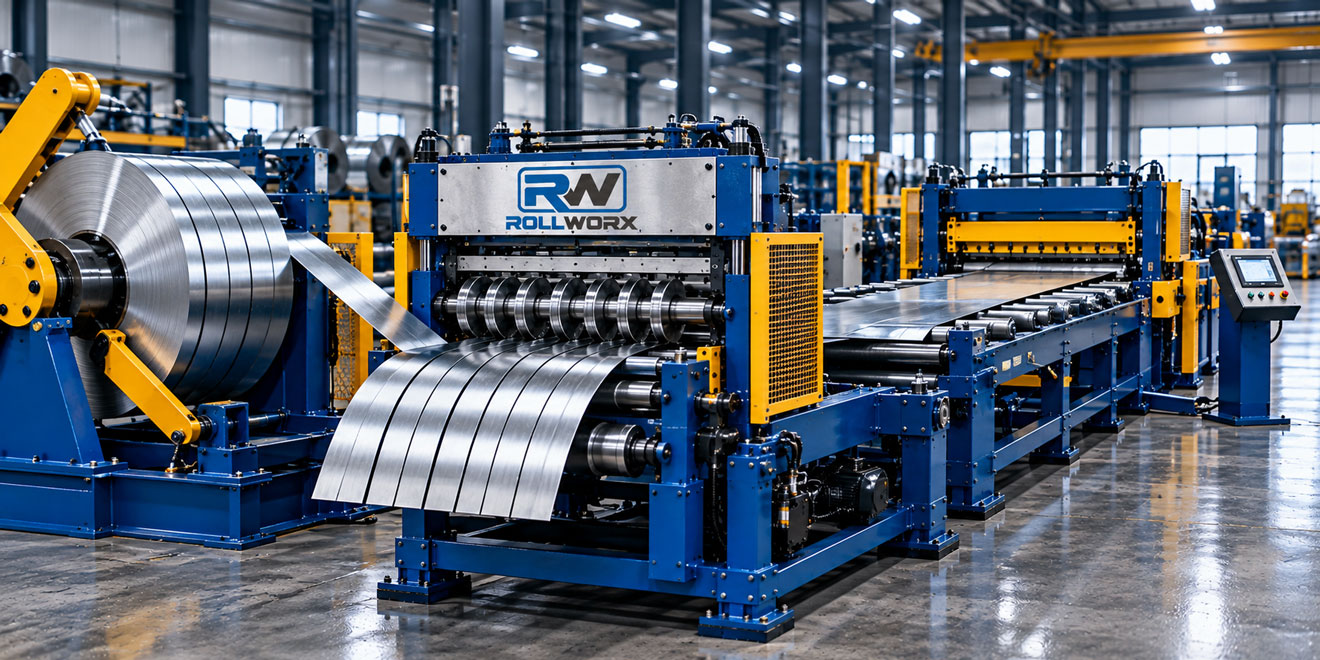
A hydraulic decoiler can make your roll-forming operation faster, easier, and more efficient, especially if you're processing coils regularly. Unlike a manual decoiler, a hydraulic decoiler uses powered expansion and controls to load, secure, and feed the coil into your roll-forming equipment. This reduces the amount of manual handling required and helps create a smoother production process.
Hydraulic Decoiler
10,000–40,000 lb Capacity
18–22 in Coil ID
up to 130 FPM Payoff
30–14 Gauge
Features

Built for Performance

Load with a forklift, not a crane

Set the coil on the car with a forklift, and the car lifts, centers, and drives the coil onto the mandrel on four guide pillars. Coil cars are rated to match each specific decoiler model.

Hydraulic expansion that holds

A four-segment mandrel expands hydraulically to grip the coil ID from 18 to 22 inches with enough force to hold a 40,000 lb coil steady in reverse. The segment faces are broad enough to protect painted stock.

Speed that follows the line

An induction loop sensor watches the strip and speeds the payoff motor up or down to match the roll former, so the strip never goes taut and never piles on the floor. Pneumatic braking stops the coil when the line stops.

Fits what you already run

Sold as part of every Roll Worx line, and sold alone to replace a manual decoiler on a machine you already own. Give us your coil ID, width, and weight and we will match the model.

Machine Specifications

RX-HD Series Specifications

Models RX-HD5 ton (10,000 lb) · RX-HD8 ton (16,000 lb) · RX-HD10 ton (20,000 lb) · RX-HD15 ton (30,000 lb) · RX-HD20 ton (40,000 lb)
Coil inner diameter 18–22 in (450–550 mm); 20 in standard
Coil width 36–48 in (900–1,250 mm); wider on request
Material thickness 30–14 ga (0.3–2.0 mm)
Materials Galvanized, Galvalume, painted steel, cold rolled, stainless, aluminum
Line speed 0–130 FPM (0–40 m/min)
Mandrel 4-segment, hydraulic expansion
Main motor 7.5 HP (5.5 kW)
Hydraulic unit 5.5 HP (4 kW)
Brake Pneumatic
Tension control Automatic induction loop sensor
Coil car Optional: Hydraulic lift and travel, four guide pillars and rated to match each specific decoiler model
Controls Electrical control box; forward / reverse / jog
Electrical 3-phase, 60 Hz; 480V or 240V
Machine Weight Approx. TBD
Foot Print 0 ft × 0 ft × 0 ft (0 m × 0 m × 0 m)
Warranty 18 Months
Options & Add-ons

Configure It for Your Operation

  • Hold-Down (Press) Arm — Keeps the outer wrap from springing when the band is cut.
  • Double-Head Decoiler — Two mandrels on a rotating base for zero-downtime coil change.
  • Coil Upender — Pair with the RX-CU30 to accept eye-to-the-sky coils.
  • Wider Mandrel — For 60 in and 72 in coil.
Downloads

Hydraulic Decoiler Spec Sheet

  • Frequently Asked Questions:

    What is the difference between a manual, motorized, and hydraulic decoiler?

    A manual decoiler is a free-spinning mandrel the roll former pulls against; fine for light coil. A motorized decoiler drives the coil so the line is not dragging it. A hydraulic decoiler adds hydraulic mandrel expansion and usually a coil car, which is what you want above about 5,000 lb.


    What capacity do I need?

    Match it to your heaviest master coil. Painted 29 ga roofing coil at 41 in usually ships at 8,000 to 12,000 lb, so a 20,000 lb unit gives you room for heavier gauge or wider coil later.


    Will it work with a roll former I already own?

    Yes. The decoiler is a standalone machine with its own hydraulic unit and controls. We match coil ID and width to your machine's infeed.


    Why do I need a coil car?

    A 20,000 lb coil does not go on a mandrel with a forklift safely. The car lifts and centers the coil and drives it on, and the same car takes the empty core off.


    What power does it need?

    3-phase, 60 Hz, 480V or 240V

Let's Build Together

Ready To Get Started?

Contact our team today for a quote or to discuss your project.
